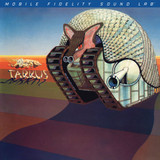
Emerson, Lake & Palmer Trilogy
(180g 33RPM LP)
MFSL1-618
$39.99
Please wait...
Current stock:
Emerson, Lake & Palmer Expand Their Fusion of Rock, Classical, and Jazz Themes on Trilogy: Includes the Hit Ballad “From the Beginning” and Interpretation of Copland’s “Hoedown”
Mastered at Mobile Fidelity Sound Lab’s Studio and Housed in a Stoughton Gatefold Jacket: Numbered-Edition 180g 33RPM LP of 1972 Album Plays with Spectacular Dynamics and Clarity
1/4” / 15 IPS / Dolby A analog copy to DSD 256 to analog console to lathe
There’s a reason Greg Lake deemed Trilogy “such an accurate record” when looking back at it decades later. Emerson, Lake & Palmer’s third studio album teems with exacting arrangements, copious overdubs, and multi-hued colors that showcase the band’s willingness to experiment and desire to put everything in its proper place without becoming too self-serious. Expanding by distilling the ferocious power of its debut and epic leanings of the preceding Tarkus into a more accessible whole, Trilogy stands as the most representative example of the ensemble’s trademark styles.
Mastered at MoFi’s California studio, housed in a Stoughton gatefold jacket, and pressed at Fidelity Record Pressing, Mobile Fidelity’s numbered-edition 180g 33RPM LP of Trilogy presents the gold-certified effort in audiophile quality marked by clear, direct, dynamic, and balanced sound. With black backgrounds, quiet surfaces, and exceptional definition, the collectible reissue brings to fore the visionary depth and virtuosic musicianship on display.
Prized characteristics — textures, tones, nuances, effects, open spaces — that go hand-in-hand with the trio’s songs and interplay are conveyed amid broad soundstages and in specific detail. Newly unveiled degrees of separation, imaging, and timing help make the compositions come across with involving presence and realism. Such sonic signposts extend to the subtle shifts in Lake’s voice on the opening cut, the mistake that prompts Carl Palmer to audibly curse at the beginning of “The Sheriff,” and the thrilling cosmic properties of the Moog synthesizers Keith Emerson employs throughout the record.
Abandoning the conceptual nature of its two immediate predecessors, the 1972 work contains familiar threads that distinguish it as an album only ELP could make. The most obvious examples are the compositions. No other band at the time wove classical, rock, jazz, and even proto-metal themes in the manner of ELP. And no collective possessed the equivalent to Emerson, Lake, and Palmer’s individual technique and symmetrical chemistry.
Trilogy is a canvas for these features and more, as well as the talents of engineer Eddy Offord, who ended his studio relationship with ELP after this project. All the better to savor this final collaboration between Offord and his English mates. Particularly given the scale-tipping production. It’s no wonder the group stopped performing several cuts live due to its frustration of being unable to replicate many parts onstage. The graduated level of complexity and layering even prompted ELP on the subsequent Brain Salad Surgery to craft songs it could faithfully recreate live.
Challenging themselves as players and writers, the members of ELP use Trilogy as a springboard for excursions into adventurous landscapes that require the expert navigation of knotty twists and turns, and the ability to change directions at a moment’s notice. The album-opening trilogy based around “The Endless Enigma” scampers, romps, and swirls as it pushes the boundaries on sophisticated time signatures all the while remaining approachable and melodic. ELP incorporates the sound of everything from church bells to beating hearts and eerie Moog synthesizers into the Trilogy scenery, with “Fugue” functioning as both an elegant breather and transition.
The band further taps classical devices for its now-iconic interpretation of Aaron Copland’s “Hoedown.” Spirited and spry, the round-we-go instrumental presents Emerson, Lake, and Palmer at their collective finest via on-point rhythms, balanced attack, and palpable energy. That the group leads into the adaptation with Western-themed storytelling on “The Sheriff” adds to the fun and coherency. And who can resist the band’s brief nod to cartoon music and Emerson’s honky-tonk piano lines during the coda?
As Lake later realized when he declared it his favorite of the group’s albums, Trilogy has it all. Fanfare flourishes and gorgeous minimalism. A Top 40 acoustic ballad (“From the Beginning”), three-section title track bolstered by fanciful grooves, and grandiose bolero (“Abaddon’s Bolero”) appointed with clever modulations and marching structures. And, for the first time, art that depicts the physical likeness of the group itself.
Designed by Storm Thorgerson and Aubrey Powell at Hipgnosis after Salvador Dali allegedly demanded a king’s ransom for the job, the portrayal conveys the philosophical and pensive qualities that emerge amid the music and narratives. Or, the visual representation of what Keith Emerson summarized in a period interview as “progressive rock with a lot of regard for the past.”
Side One:
- The Endless Enigma (Part 1)
- Fugue
- The Endless Enigma (Part 2)
- From the Beginning
- The Sheriff
- Hoedown
Side Two:
- Trilogy
- Living Sin
- Abaddon’s Bolero
Related Products