Emerson, Lake & Palmer Brain Salad Surgery
(180g 33RPM LP)
MFSL1-619
$39.99
Please wait...
Current stock:
A Most Amazing Show: Emerson, Lake & Palmer’s Brain Salad Surgery Established Prog-Rock Standards, Features the Epic “Karn Evil 9” Suite and a Visionary Rendition of a Ginastera Piano Concerto
Experience the 1973 Album in Audiophile Sound and Enjoy the Immersive Feel of the Original Double Gatefold Packaging: Mobile Fidelity’s Numbered-Edition 180g 33RPM LP Reveals the Copious Details, Textures, and Depth of the Exceptional Production
1/4” / 15 IPS analog tape to DSD 256 to analog console to lathe
"Welcome back, my friends, to the show that never ends."
Famously uttered by bassist-guitarist Greg Lake, those words encapsulate the theatricality, thrills, breadth, and fascination surrounding Brain Salad Surgery — Emerson, Lake & Palmer's fourth studio album. Originally released in late 1973, it finds the trio taking front-to-back control of its situation and incorporating several studio firsts. The platinum-certified effort also stands as one of the greatest prog-rock feats in history. Its cohesive blend of musicianship, songwriting, and production set a standard that, decades later, remains revered amid fans and critics alike.
Mastered at Mobile Fidelity Sound Lab's California studio, housed in a deluxe double gatefold Stoughton jacket complete with a fold-out die-cut insert, and pressed at Fidelity Record Pressing, the reissue label's numbered-edition 180g 33RPM LP of Brain Salad Surgery presents the record Emerson, Lake & Palmer member Carl Palmer deemed his favorite in audiophile sound. Clear, dynamic, and balanced, this collectible version honors the meticulous approaches that informed the playing and recording of the record.
Featuring black backgrounds and quiet surfaces, Mobile Fidelity’s reissue brings to light the epic scope, tonal depth, and high degree of virtuosity on display. Key characteristics — textures, nuances, effects, melodies, tempo changes — that go hand-in-hand with the trio’s compositions and interplay are rendered amid broad soundstages and delivered with pinpoint detail. Whether you’ve owned multiple copies of this touchstone or seeking out your first copy, you’ll relish the presence, separation, imaging, and solidity that help make every passage come across as the group intended.
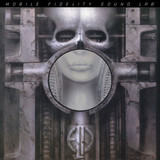
That care extends to the faithful reproduction of the original coveted packaging. Designed by iconic artist H.R. Giger, the cover visually combines an industrial machine with the top half of a human skull along with the now-recognizable ELP logo. A circular screen attached to the right panel opens to reveal another painting that shows a female face, braided hair, and lobotomy scars. On the inside panels, a portrait-style photo of each ELP member is seen within the circular space in Giger’s biomechanical illustration.
Chosen for its foreboding look, an aesthetic Keith Emerson felt conveyed the vibe of his band’s music, Giger’s paintings are one aspect of many on Brain Salad Surgery that Emerson, Lake & Palmer ensured adhered to its exacting standards. To optimize the process of making an album from start to finish, the collective established its own label, Manticore Records. Emerson, Lake & Palmer also went whole hog on its rehearsal facilities.
After the trio became frustrated by its inability to recreate large swaths of Trilogy — recorded on 24-track consoles and filled with overdubs — in the live environment, it committed to following an approach that would allow it to develop Brain Salad Surgery in organic fashion. To do so, it needed a space where it could play and write without constraints, and test out the material until it was satisfied. The solution: Emerson, Lake & Palmer purchased a cinema, removed the seats, and transformed it into a practice space.
When it came to the session work, Emerson, Lake & Palmer began at Olympic Studios and continued later that summer at Advision Studios. At the latter, the group became the first to use the then-cutting-edge polyphonic synthesizer in the context of a recording. You can hear it on “Jerusalem,” the band’s take on composer Hubert Parry’s choral adaptation of a William Blake poem. Another remarkable novelty: Palmer’s proto-electronic drums in the middle section of “Toccata,” which became a reality after the crew placed a microphone in each drum in order to trigger a synthesizer.
All that results on “Toccata” — the group’s thrilling interpretation of Alberto Ginastera’s first piano concerto — symbolizes the cacophony, ambition, and brazenness coursing through the record. To state the obvious, Emerson, Lake & Palmer’s prodigious talents as instrumentalists were a given by the time Brain Salad Surgery arrived and quickly ascended to the top quadrant of the US and UK charts. But it’s doubtful the three friends ever played more collaboratively and inspired as they do here.
You could write a thesis on “Karn Evil 9” alone. Nearly 30 minutes long and co-written by King Crimson co-founder Peter Sinfield, the prescient tale involving humans and computers evolves over three distinct movements. It finds the band pulling out all the stops, from Emerson’s Minimoog solo that mimics the character of a steelpan to the ferocious collective interplay that helps send the piece out with a flourish.
Amid such elevated rock-fusion circumstance on Brain Salad Surgery, the group has the foresight to include a beautiful moment of contrast in the form of the ballad “Still….You Turn Me On” — as fine an example as any of Lake’s ability as a poetic songwriter and finessed guitarist. Emerson contributes atmospheric backgrounds via harpsichord and accordion; Palmer simply rattles a tambourine. Though not technically representative of the other fare on the record, the tune is archetypal of period Emerson, Lake & Palmer in how it demonstrates how far the group could swing from one extreme to another and do so with absolute conviction.
A most amazing show, indeed. Step inside, step inside.
Side One:
- Jerusalem
- Toccata
- Still….You Turn Me On
- Benny the Bouncer
- Karn Evil 9: 1st Impression - Part 1
Side Two:
- Karn Evil 9: 1st Impression - Part 2
- Karn Evil 9: 2nd Impression
- Karn Evil 9: 3rd Impression
Related Products


Preorder