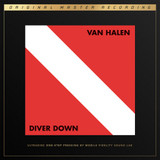
Van Halen 1984
(UD1S 180g 45RPM 2LP Box Set)
MFSL45UD1S-037
$125.00
Please wait...
Current stock:
Van Halen Goes Full Blast and Top Down on 1984: Ten-Times-Platinum Album Seamlessly Bridges Pop and Metal Sensibilities, Includes “Jump,” “Panama,” and “Hot for Teacher”
Experience Every Detail in Reference Sound: Mobile Fidelity’s UltraDisc One-Step 180g 45RPM 2LP Box Set Is Limited to 7,500 Numbered Copies
1/4” / 30 IPS analog master to DSD 256 to analog console to lathe
Ain’t nothin’ like it. Full blast and top down. Less than six years after changing the music landscape with its diamond-platinum-certified self-titled debut, Van Halen repeated the creative and commercial feats. Featuring groundbreaking performances, infectious chemistry, and four enormous singles, 1984 witnesses the band incorporating synthesizer elements that guitarist Eddie Van Halen had been championing — as well as seamlessly bridging pop and metal sensibilities into a cohesive melodic whole. A landmark that’s never aged a day, 1984 feels as fresh, fun, and innovative as it did in the Reagan Era.
Sourced from the original analog tapes, pressed at Fidelity Record Pressing, and strictly limited to 7,500 numbered copies, Mobile Fidelity’s UltraDisc One-Step 180g 45RPM 2LP box set presents the group's final album with singer David Lee Roth for nearly four decades in reference sound. Friends, you have never heard 1984 like this. Soundstaging that extends far beyond the external boundaries of your speakers; complete replication of the leading edges of notes; imaging that allows you to picture each member in an exact space; attack, timing, and physicality that come across with breathtaking balance and realism.
The traits associated with hallmark Van Halen — dynamic thunder, distinctive tonalities, vivid detail, sensory-invigorating immediacy, tongue-in-cheek playfulness, midrange punch, throttling intensity — emerge with involving presence and uncanny liveliness. Recorded with producer Ted Templeman at Eddie Van Halen's 5150 Studios in California, 1984 can here be experienced with unparalleled transparency, directness, and definition.
And, if you so choose with your volume settings, concert-like solidity, scope, and decibel levels. You can crank this version as high as you want without risking noise-floor interference or shrillness. Even if you listen at low levels, the sonic pedigree will astound you by revealing how amazing every aspect of this record is — including the quieter parts that purr and percolate.
As MoFi has continually demonstrated with its UD1S series, the premium packaging of this pressing befits its elite stature. A deluxe slipcase, thick foil-stamped jackets, and faithful-to-the-original graphics illuminate the splendor of the recording. It is for listeners who want to immerse themselves in everything about the album, including the iconic cover art that quickly became as associated with 1984 as the music itself. Regularly cited among the 100 best album covers of all time, Margo Nahas' illustration of a crying angel holding a cigarette — blending the sacred and rebellious — captures Van Halen's aesthetic to a proverbial "T."
On 1984, that aesthetic is punchy and catchy, glamorous and glitzy, blustery and heavy, wild and pyrotechnic, fast and pleasurable. From the first notes of the atmospheric title track, a precursor to the momentous synth-based anthem ("Jump") that follows, David Lee Roth, Eddie Van Halen, Michael Anthony, and Alex Van Halen hit on all cylinders until the record wraps with the stormy "House of Pain." The full-bore closer is further proof there's not a wasted note or dull moment in sight — a fact the critics and public seemingly knew the day the set landed in January '84 when reviews and sales confirmed Van Halen's status as the era's predominant hard-rock ensemble.
You could also make an argument that 1984 proved the quartet stood tall as the smartest, toughest, funniest, and savviest band in the room. Not to mention the most virtuosic. Ranked by Rolling Stone the 177th Greatest Song of All Time, "Jump" alone showcases Van Halen's flash, flair, and finesse via shimmering keyboard lines, massive hooks, conversational vocals, and one helluva muscular rhythm section. Once it grabs your attention, the collective refuses to let go for another 28 and some minutes.
Like a hot shoe burning down the avenue, Van Halen sends everything right into the red. Punctuated with the whooshed sounds of Eddie Van Halen's 1972 Lamborghini Miura S revved to 80,000 RPM, the charged electricity of "Panama” prances forward with fleet-fingered solos, spicy double entendres, and bounding architecture that goes into overdrive. Indeed, for all its deserved association with the group's detour into keyboard sounds (the Top 20 “I’ll Wait” joins “Jump” in that regard), 1984 takes your head off with a rotating assembly of explosivity, verve, sex, and surprise.
For instant evidence, look to “Drop Dead Legs.” Correctly deemed by Roth as the funkiest song Van Halen ever crafted, it mesmerizes with Eddie Van Halen’s pyrotechnic harmonics, bluesy riffage, tapped cymbals that evoke the clapping of hands, and an airy surf-rock chorus true to the group’s California origins. Yeah, you know that you want it. For “Top Jimmy,” a tribute to James Koneck and his band Top Jimmy & The Rhythm Pigs, the band romps and swings, Roth donning his vaudeville hat and scooting along to Eddie Van Halen’s glassy licks and his mates’ gliding passages. Shake it baby, indeed.
Van Halen does exactly that on the forever clever “Hot for Teacher.” Launched with one of history’s most famous drum leads — a 30-second blitz distinguished with Alex Van Halen’s superhuman-powered double-bass rolls that draw from shuffle, boogie, and metal disciplines — that feeds into another segment with classroom effects and Roth ad libs, the mega-watt classic epitomizes everything inimitable and great about Van Halen, 1984, and loose, boisterous, living, fire-breathing rock ‘n’ roll. May it reign forever.
Side One:
- 1984
- Jump
- Panama
Side Two:
- Top Jimmy
- Drop Dead Legs
Side Three:
- Hot for Teacher
- I’ll Wait
Side Four:
- Girl Gone Bad
- House of Pain
Related Products